Portfolio · NotesConsistency isn’t enough anymore
Behavioural principles need to guide decisions beyond predefined states.
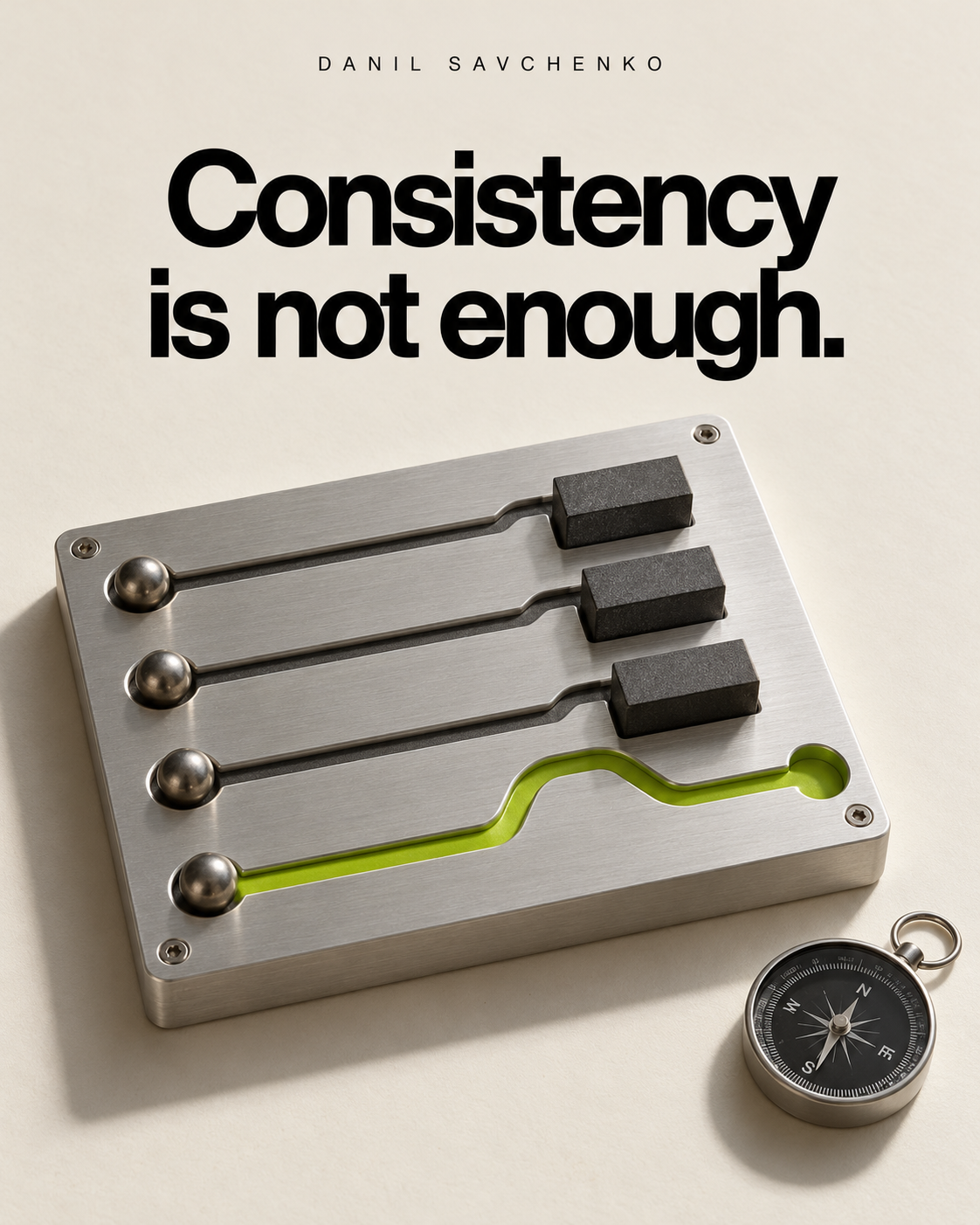
Products have become so complex that very few people know all their states. The people who hold that knowledge are valuable. They understand how the product behaves in a particular situation and why someone decided to make it work that way.
Now add non-deterministic scenarios. It gets even more interesting: you can’t design every possible branch in advance. But the person still expects the product to behave a certain way. If it does something completely unexpected, “at least it works the same way everywhere” is a pretty useless explanation.
That’s why I think behavioural principles become essential. We need to define what the system can decide on its own, when it should ask, how it handles a change of intent and what it does when it doesn’t know the answer. These principles need to guide decisions in situations we haven’t already described.
We need to build the product’s manifesto and basic ethical boundaries into the model: what’s acceptable, where the user’s instruction ends, why an assumption isn’t a fact and silence isn’t consent. They need to shape its decisions, rather than sit in a document only the team has read.
And we need to track violations as closely as we track hallucinations. A model can stick to the facts and still do something the person never asked it to do. That’s a product failure too. We need to be able to find it and count it.